Closing Ethical Gaps in Tier-3 Supply Chains: A 90-Day Strategy
Advertisements

The latest developments on Closing Ethical Gaps in Tier-3 Supply Chains: A 90-Day Strategy to Strengthen Forced-Labor Due Diligence are increasingly relevant for companies managing complex global supply networks. The most effective approach is not to promise that modern slavery can be eliminated within one quarter, but to use 90 days to establish stronger visibility, prioritization, remediation, worker engagement, and monitoring systems.
Closing Ethical Gaps in Tier-3 Supply Chains: A 90-Day Strategy to Strengthen Forced-Labor Due Diligence focuses on a practical sequence of actions that companies can begin immediately while recognizing that human-rights due diligence is an ongoing process.
The objective is to move beyond supplier questionnaires and Tier-1 checks toward risk-based assessment of deeper supply-chain relationships, especially where geography, product type, recruitment practices, subcontracting, or raw-material sourcing create heightened forced-labor risks.
The Urgency of Addressing Tier-3 Ethical Gaps
Human-rights risks often become harder to see as supply chains move beyond direct suppliers into subcontractors, raw-material processors, labor brokers, farms, mines, and other upstream relationships.
Recent OECD analysis emphasizes that companies can overlook significant risks when due diligence stops at Tier 1, making deeper supply-chain transparency increasingly important.
For U.S.-linked supply chains, these risks can also create import-compliance consequences when goods are connected to forced labor or to regions and entities covered by specific enforcement regimes.
Why Forced-Labor Compliance Matters in the United States
U.S. law prohibits the importation of goods mined, produced, or manufactured wholly or in part with forced labor under Section 307 of the Tariff Act.
The Uyghur Forced Labor Prevention Act adds a rebuttable presumption for goods produced wholly or in part in Xinjiang or by entities on the UFLPA Entity List, subject to the statute's requirements.
Companies importing into the United States therefore need traceability and due-diligence systems that can address upstream inputs rather than relying only on direct-supplier assurances.
Risk-Based Due Diligence Is More Effective Than Universal Auditing
The UN Guiding Principles and OECD guidance support a risk-based approach that prioritizes the most severe and likely adverse impacts when full diligence across every business relationship is impractical.
This means companies should focus attention on high-risk products, regions, recruitment channels, labor-intensive operations, and upstream nodes where exploitation may be more difficult to detect.
The purpose is to direct resources toward the greatest risks to workers rather than simply maximizing the number of completed audits.
Days 1-30: Map the Supply Chain and Prioritize Risk
The first 30 days should focus on understanding what is known, what is missing, and where the most serious human-rights risks may exist.
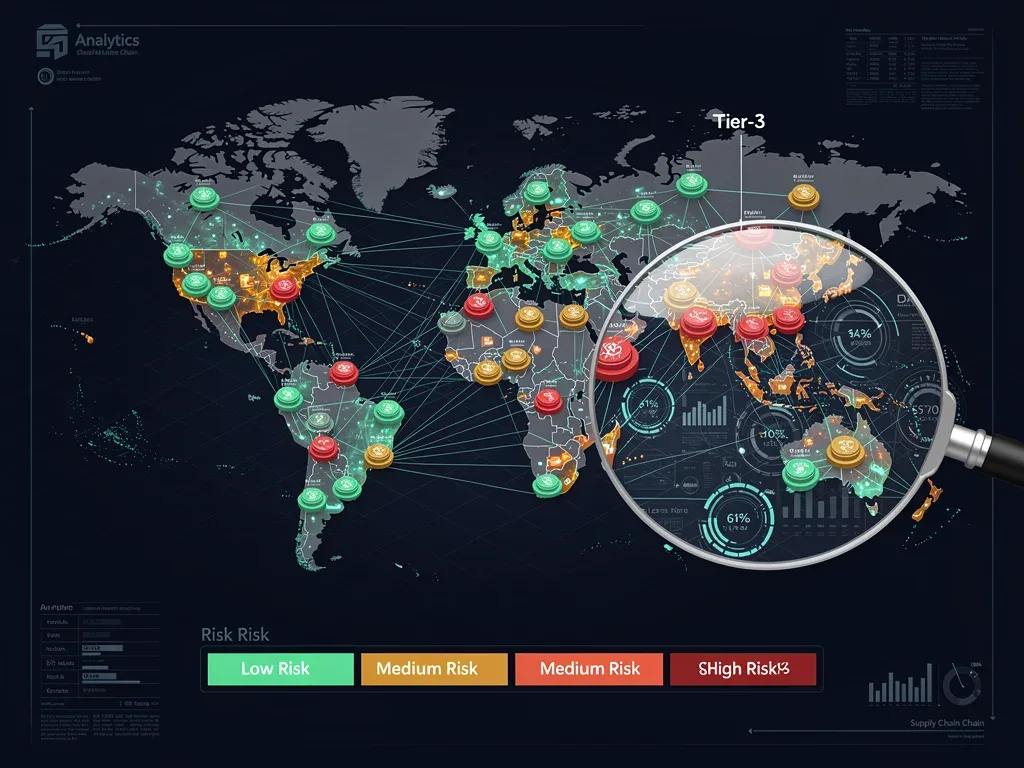
Companies should map direct suppliers, key Tier-2 relationships, known Tier-3 suppliers, raw-material origins, labor intermediaries, logistics providers, and other relevant business relationships where feasible.
The goal is not necessarily perfect visibility in one month, but a documented risk map showing known entities, unknown areas, data gaps, and prioritized lines of inquiry.
Deep Dive Into Tier-3 Visibility
Tier-3 mapping often requires cooperation from Tier-1 and Tier-2 suppliers because buyers may not have direct contractual relationships with deeper suppliers.
Supplier questionnaires, traceability records, purchase-order data, bills of materials, customs documentation, certifications, and local intelligence can help identify upstream connections.
Where visibility remains incomplete, companies should document the gap itself as a risk factor rather than assuming the absence of information means the absence of abuse.
Use Official Risk Data Where Available
The U.S. Department of Labor provides tools designed to help companies identify labor-abuse risks associated with countries, industries, and imported goods.
Resources such as SourcingStrong, LaborShield, ImportWatch, SupplyChainTrace, and the List of Goods Produced by Child Labor or Forced Labor can support initial risk screening.
These tools should inform due diligence rather than replace supplier-specific investigation, worker engagement, or remediation.
Days 1-30: Build a Forced-Labor Risk Framework
Once the supply chain is partially mapped, companies should score risks using factors relevant to worker vulnerability and forced-labor indicators.
Examples can include recruitment fees, passport retention, debt bondage, excessive overtime, restriction of movement, wage withholding, deceptive recruitment, and dependence on labor brokers.
Geographic risk, sector risk, sourcing model, contract pressure, workforce composition, and previous allegations can also affect prioritization.
Do Not Focus Only on Risk to the Company
Human-rights due diligence differs from conventional enterprise risk management because it should assess risks to people, not only financial or reputational risks to the business.
A labor practice may be highly severe for workers even when the immediate financial exposure to the buyer appears limited.
This distinction is central to the UN Guiding Principles and should shape how high-risk suppliers are prioritized.
Days 31-60: Strengthen Supplier Expectations
The second phase should convert risk findings into clear supplier expectations, escalation procedures, and corrective-action requirements.
A supplier code of conduct can define prohibited practices related to forced labor, child labor, recruitment fees, document retention, discrimination, working conditions, and freedom of association.
However, codes are effective only when they are reinforced through contracts, training, monitoring, worker access to grievance channels, and meaningful follow-up.
Supplier Engagement and Capacity Building
Corrective action is often more effective when companies understand why a violation occurred and work with suppliers to change the underlying practice.
Training can cover responsible recruitment, labor-law requirements, worker documentation, grievance systems, recordkeeping, subcontractor controls, and management accountability.
Supportive engagement should not prevent escalation when suppliers refuse cooperation, conceal information, retaliate against workers, or fail to remediate severe abuse.
Days 31-60: Establish Worker-Centered Grievance Mechanisms
Worker voice is essential because audits and management interviews alone may fail to reveal coercion, retaliation, recruitment debt, or document confiscation.
Grievance channels should be accessible, confidential, predictable, and available in languages and formats workers can realistically use.
Companies should also consider whether workers trust the mechanism and whether complaints lead to actual investigation and remedy.
Protect Workers From Retaliation
A grievance channel can become ineffective or harmful if workers believe reporting concerns will lead to dismissal, intimidation, or loss of immigration status.
Clear non-retaliation requirements should therefore extend to suppliers, labor agents, supervisors, and subcontractors.
Where serious allegations arise, worker safety and access to remedy should take priority over preserving the commercial relationship.
Days 31-60: Develop Corrective-Action Plans
Corrective-action plans should identify the violation, responsible party, required remedy, timeline, verification method, and consequences for non-compliance.
For minor procedural weaknesses, remediation may involve updated systems, documentation, training, or stronger management controls.
For severe forced-labor indicators, companies may need immediate worker-protection measures and specialized legal or human-rights expertise.
Remediation Is Different From Termination
Ending a supplier relationship can sometimes be necessary, but immediate disengagement is not always the best outcome for affected workers.
The UN Guiding Principles emphasize remediation where a company has caused or contributed to adverse impacts and encourage responsible responses to identified harm.
Businesses should therefore consider whether disengagement would worsen worker vulnerability and whether remediation can safely address the problem first.
Days 61-90: Verify Corrective Actions
The final phase of the initial 90-day plan should test whether announced changes have actually occurred.
Verification may include document review, site visits, confidential worker interviews, recruitment-record checks, wage analysis, or third-party assessment depending on the risk.
The objective is to verify outcomes rather than simply confirm that a supplier has produced a new policy document.
Audits Are Useful but Not Sufficient
Independent audits can identify important issues, but they have limitations when workers are coached, records are falsified, subcontracting is hidden, or visits are predictable.
Unannounced or semi-announced assessments may sometimes provide better visibility, but even these should be combined with worker interviews and other sources of evidence.
A strong due-diligence program treats audits as one source of information rather than as definitive proof that forced labor is absent.
Days 61-90: Build Continuous Monitoring
Human-rights risks can change after an audit because suppliers, labor brokers, sourcing locations, and production pressures can change over time.
Continuous monitoring can combine supplier data, worker complaints, purchasing patterns, shipment information, media reports, regulatory alerts, and updated country-risk information.
This ongoing process is more consistent with international due-diligence frameworks than relying solely on annual compliance reviews.
Leveraging Technology Carefully
Analytics and traceability systems can help identify anomalies, missing data, unexpected suppliers, geographic exposure, and changes in sourcing patterns.
Blockchain and other distributed-ledger technologies may support traceability in some use cases, but they do not prove that working conditions are ethical simply because transaction records are immutable.
Technology should therefore support human-rights due diligence rather than substitute for worker engagement, investigations, and on-the-ground verification.

Building a Culture of Ethical Sourcing
A durable forced-labor prevention program requires procurement, sourcing, compliance, legal, sustainability, and executive teams to share responsibility.
Purchasing practices can create labor risk when suppliers face unrealistic prices, unpredictable orders, compressed lead times, or contractual pressures that encourage unauthorized subcontracting.
Companies should therefore examine their own commercial practices rather than placing all responsibility for ethical performance on suppliers.
Leadership and Accountability
Senior leadership should define responsibility for human-rights due diligence and allocate sufficient resources to carry out the program.
Procurement teams should understand that cost, quality, and delivery targets must be balanced against labor-rights expectations.
Escalation procedures should also make clear who can pause sourcing, approve remediation, or terminate a relationship when severe violations are confirmed.
The Role of Collaboration and Partnerships
Forced-labor risks often affect entire industries and regions rather than a single company's supply chain.
Industry initiatives can support shared risk intelligence, supplier training, common standards, responsible recruitment programs, and collective remediation where appropriate.
Collaboration can be especially valuable where multiple buyers source from the same suppliers or raw-material markets.
Engaging Civil Society and Worker Organizations
NGOs, trade unions, worker organizations, and local experts may have information that conventional supplier assessments do not capture.
These groups can provide context on recruitment practices, migrant-worker vulnerabilities, local labor enforcement, and credible grievance channels.
Meaningful stakeholder engagement also strengthens due diligence by including perspectives from people who may actually experience the adverse impacts.
Understanding U.S. Forced-Labor Enforcement
U.S. Customs and Border Protection can restrict imports when goods are produced wholly or in part using forced labor under Section 307 of the Tariff Act.
The UFLPA creates additional requirements for goods linked to Xinjiang or entities on the UFLPA Entity List through a statutory rebuttable presumption.
Importers should therefore maintain supply-chain evidence capable of demonstrating the origin and production path of relevant goods and inputs.
Traceability Can Become an Import Requirement
When an import is detained or reviewed, general supplier assurances may not be enough to demonstrate that forced labor is absent.
Companies may need detailed documentation connecting raw materials, intermediate processors, manufacturers, and exporters.
This makes upstream traceability not only an ESG issue but potentially an operational requirement for maintaining market access.
Understanding California Transparency Requirements
California's Transparency in Supply Chains Act imposes disclosure requirements on certain large retailers and manufacturers doing business in the state.
The law focuses on disclosure of efforts related to verification, audits, supplier certification, internal accountability, and training concerning slavery and human trafficking.
It should not be described as a universal due-diligence mandate applying to every company operating in California.
Disclosure Is Not the Same as Full Due Diligence
A disclosure law can require transparency about company practices without necessarily prescribing every element of a human-rights due-diligence program.
Companies may therefore need broader internal controls than the minimum disclosure obligations require.
International customers, investors, or business partners may also impose contractual standards beyond California's statutory requirements.
Understanding the UK Modern Slavery Act
Section 54 of the UK Modern Slavery Act requires certain commercial organizations to prepare a modern slavery statement for each financial year.
UK government guidance was updated in December 2025 and provides practical direction on transparency in supply chains.
Companies should confirm whether they fall within the law's scope rather than assuming every business with UK connections has identical obligations.
Modern Slavery Statements Should Reflect Actual Practice
A strong statement should describe what the organization actually does to identify, prevent, mitigate, and respond to modern-slavery risks.
Publishing ambitious commitments that are not supported by systems, evidence, or implementation can create credibility and compliance concerns.
Reporting should therefore be tied to real governance, risk assessment, training, monitoring, remediation, and continuous improvement.
International Standards Provide a Broader Framework
The UN Guiding Principles on Business and Human Rights provide the globally recognized foundation for corporate responsibility to respect human rights.
The OECD Due Diligence Guidance for Responsible Business Conduct translates similar principles into a practical risk-based process covering operations, supply chains, and business relationships.
These frameworks are not identical to national law, but they are widely used as benchmarks for designing corporate due-diligence systems.
Due Diligence Should Be Ongoing
The UN Guiding Principles state that human-rights due diligence should continue over time because risks change as business relationships and operating contexts evolve.
This means a 90-day plan should be treated as the beginning of a stronger system rather than the completion of the company's responsibility.
Risk mapping, stakeholder engagement, remediation, monitoring, and reporting should continue after the initial quarter.
Measuring Impact and Continuous Improvement
Companies should track whether their actions improve conditions for workers rather than focusing only on the number of audits or supplier forms completed.
Useful indicators can include resolved worker complaints, recruitment-fee reimbursement, reduction in high-risk subcontracting, supplier corrective-action closure, and worker access to grievance mechanisms.
Metrics should be reviewed alongside qualitative evidence because a low complaint count can indicate either good conditions or lack of trust in the reporting system.
Measure Outcomes, Not Just Activities
The number of suppliers trained is an activity metric, while the reduction of prohibited recruitment fees is an outcome metric.
Both can be useful, but outcomes provide stronger evidence that a program is changing conditions rather than simply generating documentation.
Companies should refine their KPIs as their visibility and understanding of Tier-3 risks improve.
The Long-Term Benefits of Stronger Supply-Chain Due Diligence
Effective labor-rights due diligence can reduce exposure to regulatory action, supply disruption, sourcing uncertainty, and serious reputational harm.
It can also improve visibility into supplier relationships and create clearer escalation processes when problems arise.
These benefits should not be overstated as guaranteed financial returns, because the primary purpose of human-rights due diligence is to prevent, mitigate, and remedy harm to people.
Ethical Sourcing Is an Ongoing Governance Issue
Human-rights risk should be integrated into sourcing decisions, supplier onboarding, procurement strategy, contract management, and executive oversight.
A company that performs one intensive 90-day review but then returns to business as usual is unlikely to maintain reliable visibility into deeper supply-chain risks.
The strongest programs treat responsible sourcing as a continuing part of operational governance rather than a temporary compliance campaign.
Key Action Area | 90-Day Focus |
|---|---|
Days 1-30 | Map suppliers, identify Tier-3 visibility gaps, screen high-risk products and regions, and prioritize severe risks. |
Days 31-60 | Strengthen supplier requirements, worker grievance channels, training, engagement, and corrective-action plans. |
Days 61-90 | Verify corrective actions, investigate high-risk suppliers, establish monitoring, and define escalation procedures. |
After Day 90 | Continue due diligence, remediation, worker engagement, traceability, governance, and transparent reporting. |
Frequently Asked Questions About Ethical Supply Chains
Why should companies look beyond Tier-1 suppliers? ▼
Significant labor risks can exist deeper in the supply chain, including in subcontracting, raw-material production, recruitment, processing, and other upstream relationships that direct suppliers may not fully disclose.
Can a company eliminate modern-slavery risk in 90 days? ▼
No. Ninety days can establish stronger mapping, prioritization, controls, remediation, and monitoring, but human-rights due diligence is an ongoing process and cannot guarantee that forced labor will never occur.
What should companies do first? ▼
Start by mapping known suppliers and inputs, identifying data gaps, screening for high-risk products and geographies, and prioritizing severe risks to workers for deeper investigation.
Can blockchain prove that a supply chain is free from forced labor? ▼
No. Blockchain can help preserve traceability records, but accurate records do not independently prove that recruitment, wages, freedom of movement, or working conditions meet human-rights standards.
Are third-party audits enough? ▼
No. Audits can be useful, but effective due diligence also requires worker engagement, grievance systems, traceability, remediation, ongoing monitoring, and investigation of high-risk indicators.
What U.S. resources can companies use? ▼
The U.S. Department of Labor provides tools including SourcingStrong, LaborShield, ImportWatch, SupplyChainTrace, and data on goods associated with child or forced labor to support risk-based due diligence.
Looking Ahead: Sustaining Ethical Supply Chains
The 90-day strategy for closing ethical gaps in Tier-3 supply chains should establish the governance, visibility, and remediation processes needed for longer-term human-rights due diligence.
As ethical sourcing requirements evolve, businesses should expect greater emphasis on deeper-tier visibility, worker voice, traceability, responsible purchasing practices, and evidence that corrective actions actually improve conditions.
The strongest approach is therefore continuous and risk-based: identify severe impacts, prevent or mitigate potential harm, remediate actual harm, verify results, and update the system as supply chains and regulatory expectations change.